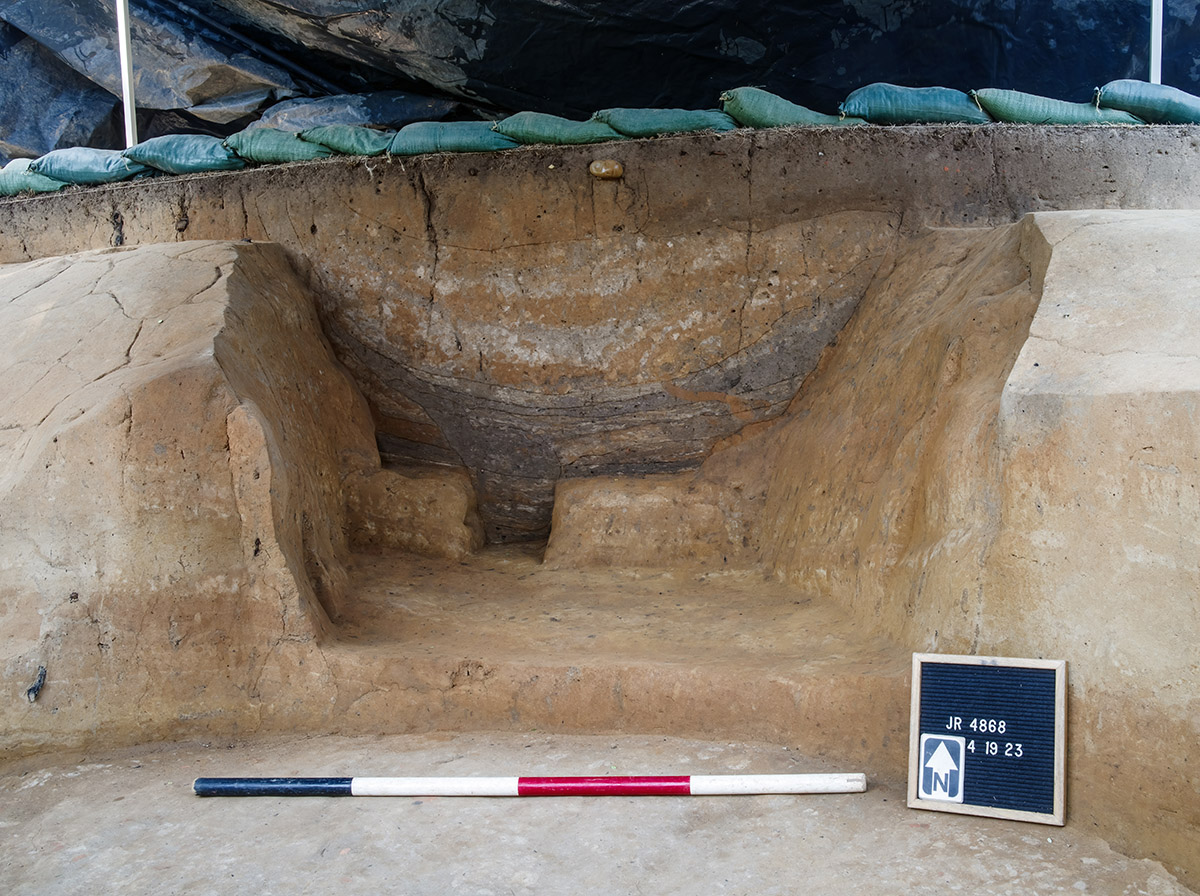


The Jamestown Rediscovery archaeologists’ excavations in and around James Fort’s eastern bulwark continue. They’re trying to learn and record all they can prior to the installation of a section of a permanent, flood-resistant and ADA-compliant pathway that will make traversing the site easier on our visitors. Although they’re working in mostly modern contexts, the archaeologists are finding plenty of early-17th century artifacts here, in an area they’re calling the Seawall excavations. The early 20th-century structure protecting the island from the James River abuts these excavations.

The layers they’re working in are a jumble of soils from different time periods. This was caused by the installation of plumbing hardware: pipes, tanks, and pumps that were put in place in the early twentieth century. As they dug several feet into the soil to install the hardware, the workers shoveled through soil layers from several different centuries, piling up the excavated earth on the surface. Once their installation was complete they used the soil to bury their handiwork, although naturally they didn’t return it in the ordered stratigraphic layers they found it in. As a result, the soil is strikingly mottled . . . the colors of several centuries of soil combined into one layer.
The twentieth century installers must have discovered quite a few artifacts as they did their work because they placed the hardware next to a midden, a trash heap thought to date to ca. 1630s-1650s. Jamestown’s archaeologists excavated much of the midden in 2020/2021 and recorded a huge number of artifacts from those excavation squares, adjacent to the current ones. The dig is being led by Staff Archaeologist Natalie Reid, though the whole team is working here, hoping to complete the work here prior to the start of this fall’s burial excavations at the 1607 Burial Ground.

As was the case with the midden excavations from 2020/2021, a ton of 17th-century artifacts are being found. In August the archaeologists excavated hundreds of ceramic sherds including North Italian slipware, Midlands purple, Roanoke Simple Stamped, Frechen, Surrey-Hampshire Border ware, delft, Westerwald, Chinese porcelain, and ceramics by Thomas Ward, a potter working at Jamestown. Other artifacts found here this month include lead shot, glass beads, a piece of a flecked glass beaker, projectile points, decorative pipes, and a rose and orb jetton (more info).

The excavations at the “West Flag” site have been backfilled. Prior to doing so, as with all sites at Jamestown, the features were mapped, recorded, and then filter fabric was laid down to separate and protect the historic layers from the backfill above. The site is called West Flag because the team was looking for the western end of the “flag” feature on the John Smith map of 1608. Assumed to be an actual flag (because it sure looks like one!) by most, our archaeologists have proven that the “flag” represents a physical structure, a ditch. The representation is largely accurate, the team having followed the ditch with ground-penetrating radar (GPR) and then “ground-truthed” portions of it with shovels and trowels.

The excavations here were made difficult by a rat’s nest of roots and bricks and the presence of Fort Pocahontas‘ moat, but the team, led by Staff Archaeologist Ren Willis, found the ditch, a corner in-fact, right as it takes a southerly turn (the top-left point of the “flag”). We are unsure as-of-yet what the ditch was used for. Was it defensive in nature? Was it enclosing something? A clue might be found on a map of another English settlement, that of Popham Colony in Maine, established just a few months after Jamestown. On the map of Fort St. George, the defensive structure enclosing the settlement, there is a flag-shaped structure on the western edge of the colony labeled “The Garden place”. The plan shows the area as surrounded by a fence or palisade, perhaps for defense or simply to protect their crops from local fauna. Notably, our archaeologists have not found any postholes that would suggest a fence or palisade existed to accompany the ditch at Jamestown.
“The Garden place” has a similar shape to the “flag” on the Smith map, and interestingly both maps ended up in the hands of the Spanish monarch Philip III via his ambassador to England, Don Pedro de Zúñiga. At this time hostilities were officially over between the two countries (Treaty of London, 1604) but the Spanish crown was displeased with English settlement in the Americas, in an area it claimed as its own. These maps could have proved valuable to a Spanish force seeking to wipe out these colonies. Jamestown’s archaeologists plan on following the ditch south in future excavations but more time-sensitive projects need to be undertaken first. Hopefully these excavations will yield clues that will inform our understanding of the structure.
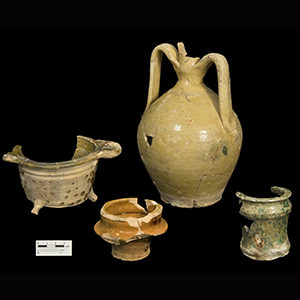
As several members of the collections team continue their work on the Surrey-Hampshire Border ware reference collection, six vessels on display in the Archaearium museum have been removed. Senior Curator Leah Stricker searched through ceramic sherds in the collections archive that were excavated from the three fort-period contexts (the John Smith Well, the Blacksmith Shop/Bakery, and the Factory) where the vessels were found. Sure enough, she found many sherds that belong to the vessels pulled off display, and several that mend, meaning they’ll be more complete when they go back on display.
The ball is now in Conservator Jo Hoppe’s court. Jo will be doing the actual mending. As with many other conservation projects that involve retreating previously-conserved objects, Jo is first taking these objects apart. She’s removing all of the existing adhesive, cleaning the vessel, and then applying a newer, more stable adhesive that wasn’t used at the time when these objects were initially mended over twenty years ago. Additionally, context labels are now applied on the side of the sherds that face the interior of the vessel. Previously they were applied to the sherds’ edges, making them impossible to see once mended and also creating a thin wedge that could cause issues during mending.

Jo is currently working on two pipkins, both excavated from the John Smith Well (the colony’s first), that were among the vessels taken off display. Pipkins were used in cooking. Food was placed inside the pipkin and they had legs which supported the vessel when it was placed directly in a fire. A stick was inserted into a hollow handle so that it could be moved in and out of the fire at a distance. After her mends Jo notes that the smaller of the two pipkins she’s working on will be nearly complete. The larger one will be substantially more complete as well.

Ceramics aren’t the only artifacts being taken off display for mending. Associate Curator Lauren Stephens has taken some notable glass artifacts out of the Archaearium and into the Vault where she is searching for additional pieces that might belong to them. One of these objects, a bluish-green drinking glass, was probably made within present-day Germany. The vessel is made up of five joined fragments and Lauren has found several more pieces that could belong to it while searching through artifacts from the Factory, the feature where the existing pieces were found. The vessel is quite ornate; the base of its bowl is decorated with a pincered notched skirt and above it lies a row of knops under a trailed line. The glass has been exposed to fire, causing scorch markings and even melting. Because of the heat, one side of the vessel partially melted and fell into the other side, making contact before hardening again. The stem has also partially melted and deformed as a result.
Lauren explains that glass mending can be more challenging than ceramics mending due to glass degradation. As glass is exposed to moisture, it’s exterior layers undergo a chemical reaction that causes those layers to flake off. Because of this, its shape can be quite different after 400 years in the ground than when it was made. When mending ceramics, our collections staff can run their fingers along the edges of sherds to pick up on shapes difficult to see with the naked eye. They use their sense of touch to help determine if one sherd mends to another. But because the edges of glass are misshapen by degradation, the “finger test” can’t be used with certainty. Instead, our collections staff examine the glass artifacts under a microscope to look for tiny physical commonalities that might suggest a mend.

Lauren is searching for mends to another glass vessel, an especially ornate wine goblet done in the Façon de Venise (French for “Venetian fashion”) style. It was either manufactured in Venice or made by someone imitating the forms created there. Only the stem has been found so far, but its form suggests this was quite an expensive drinking vessel. Hollow glass tubes wrap around the stem and tiny ridges cover the tubes and the stem they surround, in a form sometimes called verre à serpent (“snake glass”). Lauren’s job is much harder for this vessel because the stem was found in the plowzone, the area near the surface where farmers’ plows have churned up the soil, mixing different layers together. Not only do plows mix different layers vertically, they can also drag soil (and artifacts!) several feet horizontally from its original position.

Jamestown Island was home to centuries of farming both during and after its time as Virginia’s capital. As a result, the plowzone covers a large portion of the area that our archaeologists work in, as evidenced by “plow scars”, narrow sections of discolored soil caused by the plow blades churning up older layers into one new, larger homogeneous layer. Artifacts found in the plowzone are by definition out of context, that is, they are no longer where they were originally deposited. This makes dating artifacts or determining what they were used for much more difficult. It can’t be assumed that an artifact in the plowzone came out of a nearby historic feature because of possible movement caused by plows, especially in light of there typically being multiple historic features close to one another at Jamestown.
Having said all of this, while searching through the archives on the Vault’s second floor, Lauren will start her search for additional pieces looking through artifacts excavated from features near where the Façon de Venise wine goblet was found. Although she will have the highest odds finding fragments excavated close by, our team regularly finds different pieces of the same object in different features or layers (called “cross mends”), occasionally as far as hundreds of feet apart.


Lauren is also searching through the archive of Factory artifacts for additional pieces to the gilded glass plate discussed in March’s update. She has found five new sherds so far, one of which gives us a glimpse of the vessel’s color prior to glass degradation. Because glass vessels degrade from the surface inwards, caused by exposure to exterior moisture, the center of the glass has the best chance of surviving intact. One of the new pieces that Lauren found is just like that, having a sliver of glass that is untouched by the chemical processes causing glass degradation. Although it looks almost black, it is actually a cobalt blue. The conservation team is holding off on mending the new pieces to make sure they have found all they can in the artifact archive. Finding a new piece after the mending starts can sometimes mean taking it apart again if the new piece can’t fit without first removing an existing mend.
The conservation process never ends, even when an object goes on display in the Archaearium museum. Our conservators perform regular inspections of the artifacts there to check if an object needs retreatment or is having another issue. They also seek to improve the presentation of our objects when they can. The Archaearium is twenty years old now and as with other fields, the methods and best practices of museum object display are constantly evolving. Senior Conservator Dr. Chris Wilkins is seeking to improve the display of some of our Virginia Indian ceramics, now that his fellow collections staff have found additional sherds in the artifact archive and mended them to existing vessels that were already on display.
Additional mends often mean that existing mounts will no longer provide adequate support, and that is the case with several of the vessels Chris is working with. As he’s designing new supports, he is tailoring them with some of the aforementioned best practices in mind. While first and foremost he wants to create a new mount that will fully support the vessel, he is striving to make the mount “disappear” from afar while being obviously separate from the artifact upon closer inspection.

One of the supports Chris is working on is for a Native ceramic pot, made more complete through the efforts of our curators, conservators, and interns. Native pots are difficult to display in their proper orientation because they were conical — designed to wedge into the coals of a long-running fire. Chris wants to create a mount that displays the vessel in its proper upright position though without forsaking support. He’s using a product made by 3M called Microballoons which he molds into a shape that properly supports each section of the vessel. Microballoons are tiny hollow glass spheres that are lightweight and chemically stable, chemical reactions being one of the things conservators try to prevent for the sake of an artifact’s health. Their hollowness gives them their lightness, a boon to mount makers whose craft is often at odds with gravity.

One of the goals with mounts like this is to make them as unobtrusive as possible. From a distance, he’d like the mount to be almost invisible. He can do this by painting the completed Microballoons shape the same color as the plinth it sits on or the wall behind it. But if someone were to take a closer look, he’d want it to be obvious that the mount is not part of the vessel. Microballoons can also be molded to fill a gap in an object, such as when a ceramic vessel has mends that are missing load-bearing pieces beneath them. These Microballoon “pieces” would give support to vessels, when without them the risk of collapse might otherwise preclude the object from going on display. But when this technique is used it is especially important to make it obvious that the Microballoons are not part of the object.

Curator Janene Johnston was a world traveler in August and early September, sharing the results of her research with attendees of two conferences. Janene’s presentations focused on her firearms-related collections research that resulted in reference collections for several of these artifact types. Janene first traveled to the Buffalo Bill Center of the West in Cody, Wyoming where she presented “Matchlocks & Musket Rests: Firearms and Related Artifacts from 17th-century James Fort” at the Arsenals of History symposium. Then in early September she presented “Gear for the Musketeer: Firearms Accessories from James Fort, Virginia” at the Fields of Conflict conference in Glasgow, Scotland. Sharing the results of our research with peers is an important part of our work.
dig deeper
related images
-

- Archaeological Field Technician Eleanor Robb explains the Seawall excavations to visitors.

-

- Jamestown’s archaeologists at work at the Seawall dig

-

- Archaeological Field Technician Eleanor Robb uses a Dutch shovel to remove a thin section of soil at the Seawall excavations.

-

- Staff Archaeologist Ren Willis excavates lead sprue from the Seawall dig area.

-

- Lead sprue found at the Seawall excavations. The nubs projecting from the sprue indicate where shot was before being clipped off.

-

- Archaeological Field Technician Eleanor Robb and Staff Archaeologist Natalie Reid carefully excavate small artifacts from the brick rubble feature at the Seawall dig site.

-

- Archaeological Field Technician Eleanor Robb and Staff Archaeologist Natalie Reid excavate lead scrap at the Seawall dig.

-

- Lead scrap excavated from the Seawall dig

-

- Staff Archaeologists Ren Willis and Natalie Reid pose with the brick rubble feature at the Seawall excavations.

-

- Staff Archaeologist Natalie Reid risks becoming part of the archaeological record.

-

- Excavations at the Seawall

-

- Archaeological Field Technician Katie Griffith removes modern fill near (inactive) electrical lines at the Seawall excavations.

-

- Plumbing pipes and conduit containing electrical wires installed in the early twentieth century. The placement of the plumbing infrastructure mixed historic and modern layers in the Seawall excavation area.

-

- Staff Archaeologist Ren Willis shares an artifact found at the Seawall excavations with visitors.

-

- Seawall excavations overview

-

- Rubble found while waterscreening soil from a brick-laden feature at the Seawall dig.

-

- Archaeological Field Technician Eleanor Robb holds a sherd of a Delft tile found at the Seawall excavations.

-

- A rose and orb jetton found at the Seawall excavations

-

- Archaeological Field Technician Amelia Fahl holds a Morrow Mountain II projectile point she found at the Seawall excavations.

-

- A Nueva Cadiz bead found while waterscreening soil excavated from the Seawall

-

- Archaeological Field Technician Natalie White holds a sherd of tin glazed earthenware she found at the Seawall excavations.

-

- A screen of artifacts from the Seawall excavations

-

- The leg of a Surrey-Hampshire Border ware pipkin found at the Seawall excavations.

-

- Three decorated pipestems found at the Seawall excavations

-

- Shot and other lead artifacts found at the Seawall excavations

-

- A sherd of Westerwald ceramic found in the Seawall dig in August

-

- The tip of a projectile point found at the Seawall dig

-

- Portions of a jar, including a rim sherd, found at the Seawall excavations. This jar was made by Thomas Ward, a potter at Jamestown.

-

- A pipe found at the Seawall excavations has a crosshatch pattern on its heel

-

- A nearly complete Morrow Mountain II projectile point found at the Seawall excavations

-

- A sherd of Native ceramic found at the Seawall. The exterior shows impressions from a cord-wrapped paddle used to form the vessel.

-

- A sherd of Chinese porcelain found at the Seawall excavations

-

- Two sizes of shot found at the Seawall excavations

-

- A pipe bowl found at the Seawall excavations. Its heel is imprinted with the initials ‘WC’ as a decorative design.

-

- A pipe bowl found at the Seawall excavations bears a fleur-de-lis on its heel.

-

- A handle for a ceramic vessel found at the Seawall excavations

-

- A small blue glass bead found while screening soil excavated from the Seawall excavations

-

- Archaeological Field Technician Eleanor Robb excavates a partial ceramic vessel found in the Seawall excavations.

-

- Sherds of a ceramic vessel found in the Seawall excavations

-

- The partial beard of a Bartmann jug found at the Seawall excavations

-

- Site Supervisor Elizabeth Tarulis, Archaeological Field Technician Amelia Fahl, and Staff Archaeologist Ren Willis at work at the West Flag excavations.

-

- The leather artifact at the West Flag dig

-

- Archaeological Field Technician Katie Griffith and Staff Archaeologist Ren Willis remove a leather artifact from the West Flag excavations.

-

- A leather artifact found at the West Flag excavations. Preliminary examinations suggest it may be part of a shoe but it likely dates to well after the colonial period.

-

- Pieces of a Surrey-Hampshire Border ware pipkin being conserved by Conservator Jo Hoppe.

-

- Conservator Jo Hoppe uses a scalpel to remove stubborn bits of adhesive from a prior mending before mending it again. Bits of old adhesive, dirt, or other materials can prevent a tight mend, the effects of which can cause misalignment for this and other sherds. This is part of a Surrey-Hampshire Border ware pipkin found in James Fort’s first well.

-

- Light shines through the edge of one of the gilded plate fragments, revealing its cobalt blue color.

-

- Assistant Curator Lindsay Bliss describes the archaeology of the Kitchen and Cellar to visitors.